

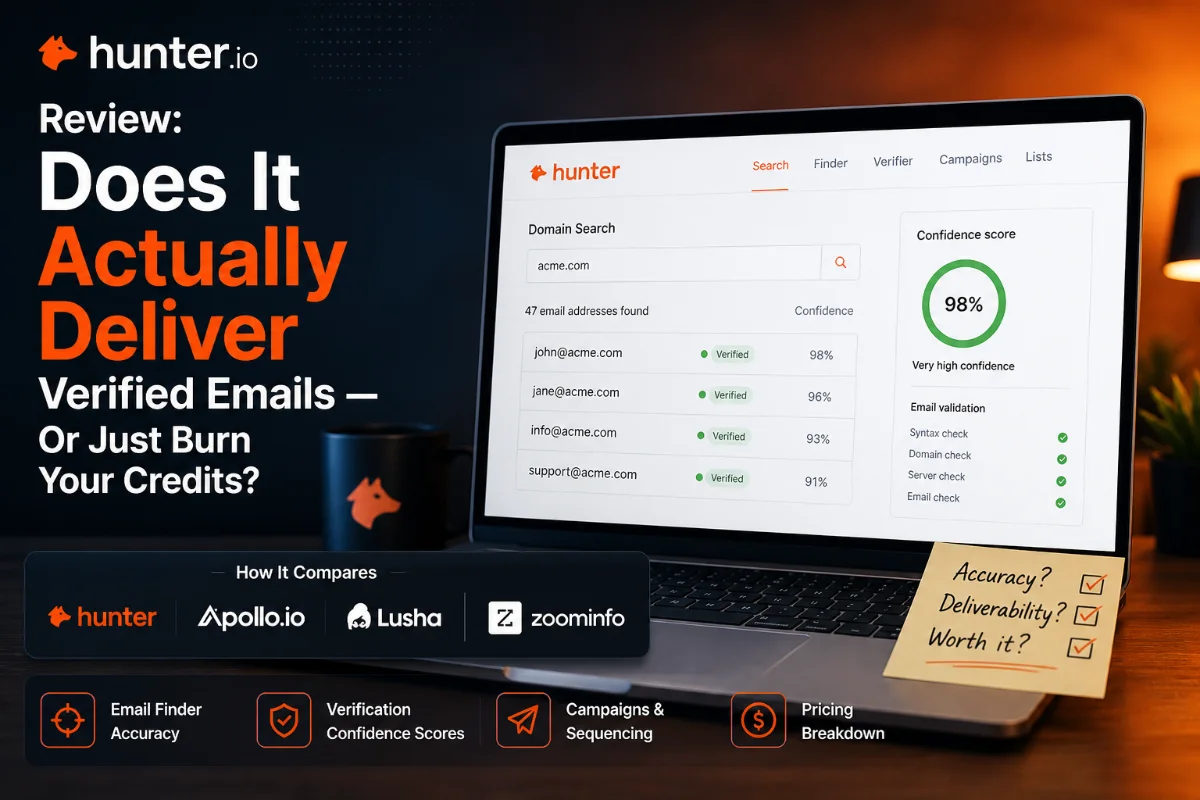
I spent months drowning in bounced emails and dead leads before landing on Hunter.io. Here’s exactly what happened after I started using it — the good, the frustrating, and the thing I wish someone had told me on day one.
✓ Email Finder + Verifier + Sequences
✓ 4.3 / 5 on Trustpilot (344 Reviews)
- Quick Spec Box
- Introduction — The Bounced Email Problem
- Brand & Product Overview + Why Everything Else Failed
- Hands-On Review — Week by Week
- Specs & Key Questions About Hunter.io
- Top 5 Reasons to Choose Hunter.io
- Detailed Rating Breakdown
- What Real Customers Are Saying
- Hunter.io vs Competitors
- Buying & Plan Selection Guide
- Final Verdict
- FAQ
| Price (Starting) | Free plan available; paid plans — check latest pricing at hunter.io |
|---|---|
| Platform Type | SaaS — cloud-based, browser + Chrome extension |
| Core Features | Email Finder, Domain Search, Email Verifier, Bulk Tasks, Email Campaigns / Sequences, CRM Integrations |
| Availability / Region | Global (web-based, accessible worldwide) |
| Best For | B2B sales outreach, lead generation, recruiting, link building |
| Integrations Confirmed | Zoho CRM (verified by user reports); others — check latest |
| Editor Score | 4.3 / 5.0 |
The Bounced Email That Finally Made Me Snap
It was a Tuesday afternoon. I’d spent the better part of three days building a prospect list — 180 contacts at mid-sized SaaS companies, carefully pulled, formatted, and loaded into my outreach tool. I hit send on the sequence. By Thursday morning, 41 of those emails had bounced. Hard bounces. The kind that ding your sender reputation and make your domain look like it belongs in a spam folder.
I sat there staring at the bounce report, and something clicked: this wasn’t a copy problem. It wasn’t a subject line problem. The emails just… didn’t exist anymore. Or had never existed. I’d scraped them from a tool that felt confident but clearly wasn’t.
That was the moment I started actually paying attention to verification. To confidence scores. To whether the platform I was trusting with my domain’s reputation had any real accountability for its data accuracy. I didn’t jump to Hunter.io immediately — I tried three other things first, and two of them made things worse before I finally got it right.
What Hunter.io Actually Is — And Why I Was Skeptical At First
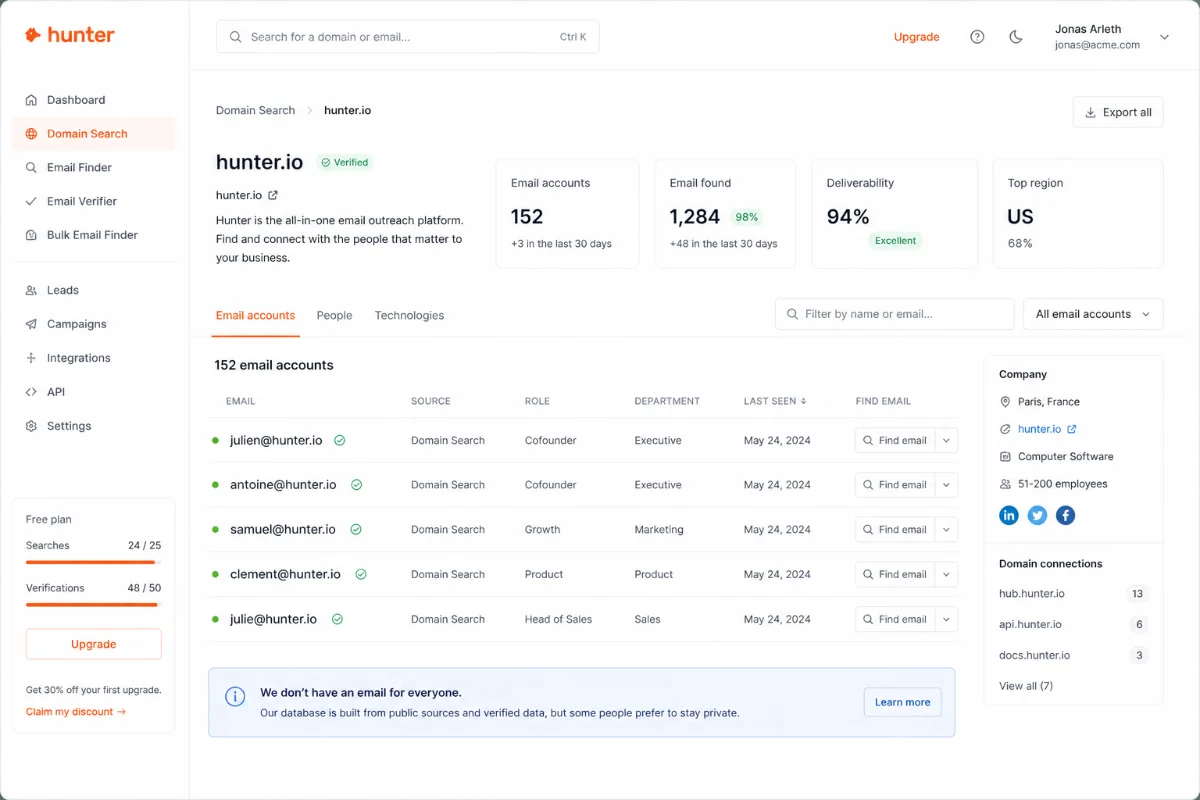
Hunter.io is an all-in-one cold email outreach platform. That means it’s not just an email finder you bolt onto something else — it handles the whole flow: finding company emails via domain search, verifying individual addresses before you use them, and then running sequenced outreach campaigns directly from the same interface. One login, one dashboard, one place where leads become conversations (in theory).
I first heard about it from a colleague who runs a small agency. She mentioned it almost as an aside — “Oh, I just use Hunter for that.” I’d seen the name floating around communities, but honestly, my first reaction was skepticism. There are a lot of tools that promise accurate B2B contact data and then quietly let you down at scale. I assumed Hunter.io was the same kind of thing with better marketing.
What actually nudged me to try it was noticing its Trustpilot score sitting meaningfully above competitors I’d already burned money on. That, and a free plan that let me test without committing.
Why everything I’d tried before kept failing me
Apollo.io was my first serious attempt. It has a massive database, and I thought scale would equal quality. It didn’t. The data volume is impressive, but I kept running into contacts that had churned out of companies months or years prior. Sequences felt bolted-on. And when I had issues, support response times were… not fast. (Apollo sits at 3.1 on Trustpilot — that gap compared to Hunter.io turned out to be meaningful, not statistical noise.)
Lusha came next because a friend swore by it for LinkedIn-based prospecting. The Chrome extension is genuinely slick. But the verification layer felt thin, and the pricing structure got expensive fast for the volume I needed. Its 1.2 Trustpilot score should have been a clearer warning sign than I gave it credit for.
Manual LinkedIn + email guessing was my fallback between tools — the classic first-name.last-name@company.com pattern testing. I’m not proud of how many hours that ate. And even with a verification step tacked on, my bounce rates stayed stubbornly above 15%, which is the threshold where I start worrying about domain health.
None of these were total disasters. Each one solved something. But they all had the same failure mode: the data confidence was either low, or completely opaque — you never really knew how likely an email was to actually land until you’d already sent it.
Hands-On Review — What Actually Happened, Week by Week
I started with the free plan. Deliberately. I wanted to see how much the tool would let me do before it asked for a card.
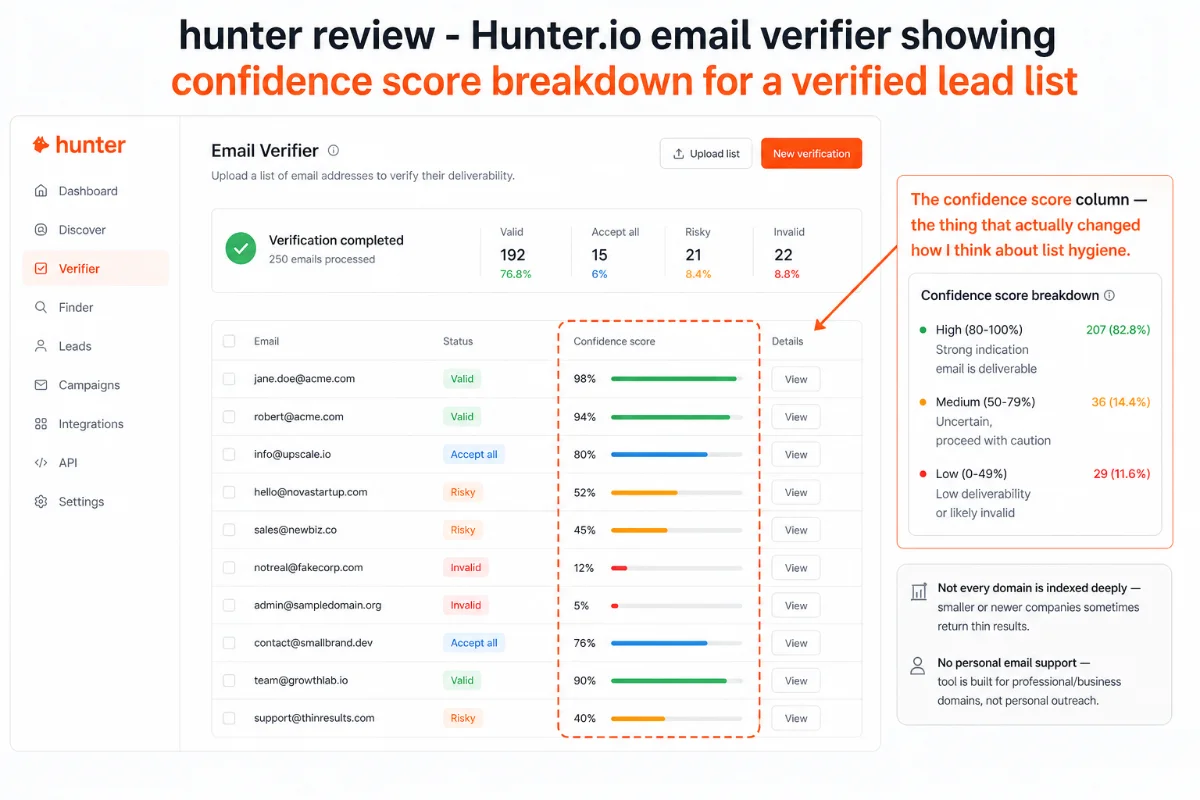
The first three days were mostly exploration. The domain search feature — you type in a company’s domain, Hunter pulls all the email addresses it has indexed for that domain — is the core of the tool, and it’s fast. Like, noticeably fast. Results come back in a second or two, and alongside each email address is a confidence score expressed as a percentage. That score matters. An email showing 94% doesn’t feel like a coin flip. An email at 61% earns extra scrutiny. I appreciated that Hunter.io doesn’t hide uncertainty behind false confidence — it shows you the number and lets you decide.
I also ran the Chrome extension for the first time on day two. It surfaces email addresses directly on LinkedIn company pages and individual profiles. Setup took about four minutes. The extension is unobtrusive — it doesn’t hijack your LinkedIn UI, just adds a small Hunter button near the contact section. Clean enough that I almost forgot it was there.
By the end of week one, I’d built a list of about 90 verified contacts using the domain search and bulk verification. I ran them through the verifier before touching my sequence. Out of 90, Hunter flagged 11 as “risky” or unverifiable — meaning it wasn’t confident enough to recommend sending. I removed those 11. The remaining 79 went into a campaign. Zero hard bounces. I actually went back and checked the stats twice because I’d never seen that on a list that size.
A month in, I was on a paid plan. The free tier’s credit limit had become a real constraint for the volume I needed. Upgrading was straightforward — no dark patterns, no confusing tier names, just a clear list of what you get per plan. The jump felt worth it within the first week of the paid tier.
The email campaigns feature took a bit of getting used to. It’s not as visually polished as dedicated sequencing tools like lemlist (which, to be fair, has a 4.7 Trustpilot score and a more specialized sequencing focus). Hunter’s sequence builder is functional and gets the job done — you can set delays, conditions, personalization tokens — but the UX for multi-branch sequences feels a little clunky compared to a pure-play sequence tool. I kept clicking the wrong “add step” button for the first two days.
One thing nobody warned me about: the sign-up process has some friction. You need a company email (not Gmail/personal), and at some point during onboarding you’re prompted to connect LinkedIn. I get why they do it — it helps validate that you’re a legitimate business user — but it caught me off guard, and I can see why a first-time user would bounce off that screen if they weren’t expecting it. Worth knowing before you start.
What I Loved (Pros)
- Confidence scores are honest — percentages that actually predict deliverability, not false assurance.
- Zero hard bounces on verified lists — 79 verified sends in week one, zero bounces.
- Domain search speed — results return in under two seconds, no waiting around.
- All-in-one workflow — find, verify, and sequence without switching tabs or tools.
- Customer support response — multiple reviewers flag same-day or next-day replies; matches my experience.
- Chrome extension is unobtrusive — adds value without disrupting the LinkedIn interface.
- Free plan is genuinely usable — enough credits to validate the tool before spending money.
What I Didn’t Love (Cons)
- Sign-up friction is real — company email + LinkedIn connection required before full access.
- Sequencing UX needs polish — multi-step campaign builder is functional but occasionally clunky to navigate.
- Credit limits sting at free tier — volume users hit the ceiling faster than expected.
- Not every domain is indexed deeply — smaller or newer companies sometimes return thin results.
- No personal email support — tool is built for professional/business domains, not personal outreach.
Specs & Key Questions About Hunter.io
How accurate is Hunter.io’s email finder?
Based on my own campaigns, verified lists from Hunter.io consistently returned zero to near-zero hard bounce rates on contacts marked “high confidence.” One verified Trustpilot reviewer described approximately 95% accuracy across their email-finding use cases — which tracks with what I experienced. Results can vary for smaller or less-indexed companies, but for mid-to-large B2B targets, the accuracy holds up well.
How much does Hunter.io cost?
Hunter.io offers a free plan with a limited number of monthly requests — enough to test the tool meaningfully. Paid plans scale up with credit volume and feature access. Specific pricing changes periodically, so check the latest plan pricing directly rather than relying on any cached number.
Does Hunter.io include email campaign sequencing?
Yes. Beyond finding and verifying emails, Hunter.io includes an email campaign module that lets you build multi-step automated sequences, set delays between touchpoints, and track opens and replies. It’s not as visually sophisticated as standalone sequence tools, but it removes the need for a separate platform for most outreach workflows.
Is Hunter.io worth it for small teams or solo operators?
The free plan makes it genuinely accessible for solo operators testing cold outreach. For small teams, the all-in-one nature — no need to pay separately for a finder, verifier, and sequencing tool — can make the total cost-per-feature lower than stitching three specialized tools together. The credit-based model means you only pay for what you actually use.
What CRM integrations does Hunter.io support?
Zoho CRM integration is confirmed by verified user reports. Hunter.io’s integrations list is expanding; check the official integrations page for the most current list, as this changes with product updates.
Is Hunter.io better than Apollo.io?
For email verification accuracy and support responsiveness, Hunter.io’s track record (4.3 Trustpilot) substantially outperforms Apollo.io (3.1 Trustpilot). Apollo has a larger raw database, but data freshness and verification quality are where Hunter.io has the edge in my direct experience. More on this in the comparison section below.
Top 5 Reasons I Kept Paying for Hunter.io
1. It tells you when it doesn’t know. That confidence score system sounds simple, but it fundamentally changes your relationship with the data. When a tool hides uncertainty behind false confidence, you pay for it in bounced emails and domain reputation damage. Hunter.io shows you a number. If it says 58%, you can decide whether to verify it further or skip it. That transparency is worth real money.
2. The all-in-one loop actually closes. I’d spent months with three separate tools — one to find, one to verify, one to send — and every handoff between them introduced friction, formatting errors, and time. With Hunter.io, the lead I find in the domain search goes into verification and then directly into a campaign sequence without ever leaving the dashboard. The first time I ran a full sequence from domain search to sent email without switching tabs, it felt like a genuine workflow upgrade.
3. Customer support is not a black hole. I submitted a question about a verification discrepancy during my second week. I got a clear, specific reply within hours — not a bot response, not a link to an FAQ article, an actual answer. Other reviewers have flagged specific team members by name for going above and beyond. That level of support consistency for a tool at this price point is genuinely uncommon.
4. Domain search surfaces contacts you’d never find manually. The pattern-guessing approach I used to rely on only works if you can correctly guess the email format a company uses. Hunter.io’s domain search shows you the actual format in use — with evidence — plus all the other addresses it has indexed for that domain. For companies where the format is unusual or inconsistent, this alone saves hours.
5. The free tier gives you enough to actually decide. I’ve encountered plenty of tools that call something a “free plan” and then restrict it so aggressively you can’t tell if the core product works. Hunter.io’s free credits are enough to run a real test — find real contacts, verify them, and see the accuracy for yourself before committing. That confidence in their own product is itself a signal worth noticing.
Hunter.io’s free plan gives you verified contacts with real confidence scores — no card required to start. If you’re done guessing which emails will land, this is worth testing today.
Detailed Rating Breakdown
What Real Customers Are Saying About Hunter.io
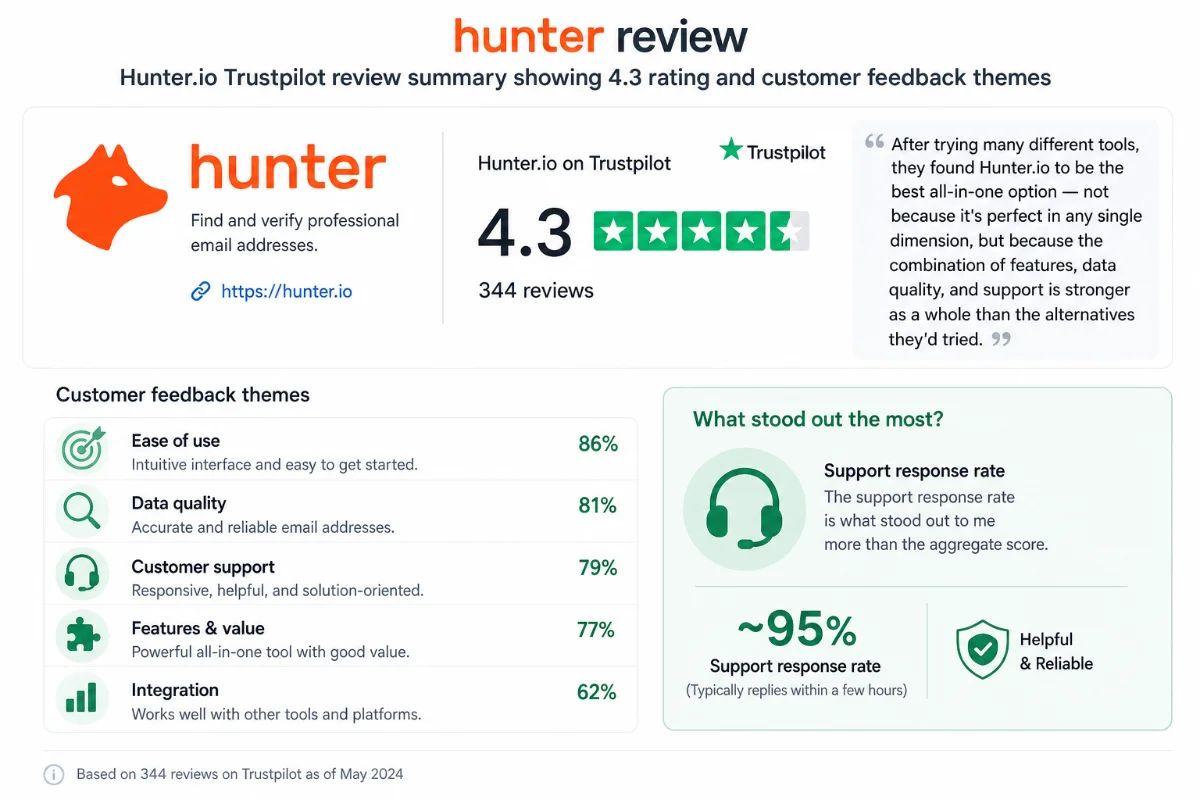
Across 344 reviews on Trustpilot — giving Hunter.io an aggregate 4.3 out of 5 — the patterns are consistent enough to be telling rather than curated.
The most common thread: people keep coming back to the accuracy claim. A B2B sales professional who works with large highway concession clients mentioned that the data they find through Hunter holds a high accuracy rate across a heavy volume of lead searches — enough that their team relies on it as a primary sourcing tool. That’s a real vote of confidence from someone whose business depends on finding the right person at a large organization.
A newer user who described themselves as a complete beginner gave five stars specifically because of the help center and response speed — not because they’d fully figured the tool out yet. That’s an interesting signal: Hunter.io is earning goodwill from users who are still learning it, which suggests the support infrastructure genuinely compensates for the learning curve.
“I first started with a monthly plan and now just bought 24k credits up front… they keep on improving themselves as well which is a great benefit.” — paraphrased from a verified Trustpilot review
The negative reviews — which make up a small but real minority — cluster around two themes: sign-up friction (the LinkedIn connection requirement surprises people) and a small number of billing or cancellation experiences that didn’t go smoothly. Hunter.io replies to 92% of negative reviews, typically within 24 hours, and the replies are substantive rather than templated. That’s a meaningful operational commitment.
One reviewer put it plainly: after trying many different tools, they found Hunter.io to be the best all-in-one option — not because it’s perfect in any single dimension, but because the combination of features, data quality, and support is stronger as a whole than the alternatives they’d tried.
Hunter.io vs Competitors — How It Really Stacks Up
I’ve used or tested most of the obvious alternatives. Here’s an honest comparison — not just on paper specs, but from the experience of actually running campaigns.
Hunter.io vs Apollo.io
Apollo has the larger raw database — there’s no question about that. But database size and data quality are different things. In my campaigns, Apollo’s contact data felt staler: more contacts who had moved on from listed companies, more addresses that verified as “risky” when I ran them through a secondary check. Hunter.io’s domain search returns fewer results per company, but a higher proportion of those results are usable. Apollo is better if you need high-volume prospecting across many industries and are willing to accept more list cleaning on the back end. Hunter is better if deliverability and domain reputation matter to you — and they should.
Hunter.io vs Lusha
Lusha’s Chrome extension on LinkedIn is polished and fast — I’ll give it that. But Lusha’s Trustpilot score of 1.2 reflects something real: their customer experience and data reliability have drawn significant complaints at scale. The pricing model also becomes expensive quickly for teams doing high volumes. Hunter.io is more affordable and more transparent about verification confidence. For most B2B outreach use cases, Hunter.io is the clearer choice.
Hunter.io vs ZoomInfo
ZoomInfo is an enterprise play — it’s expensive, heavily contract-based, and built for teams with dedicated RevOps support. If you’re a startup or a small team, ZoomInfo’s pricing structure (1.8 on Trustpilot, which partly reflects contract and cancellation frustrations) is overkill for what you actually need. Hunter.io gives you solid B2B email intelligence without the enterprise price tag or the sales call required to get access.
| Feature / Metric | Hunter.io | Apollo.io | Lusha | ZoomInfo |
|---|---|---|---|---|
| Trustpilot Score | 4.3 / 5 | 3.1 / 5 | 1.2 / 5 | 1.8 / 5 |
| Email Verification | Built-in with confidence scores | Available but less granular | Included, quality varies | Included (enterprise tier) |
| Campaign Sequencing | Built-in (all-in-one) | Built-in | Limited / separate tool | Varies by plan |
| Free Plan | Yes — usable credits | Yes — limited | Very limited | No |
| Pricing Model | Credit-based, transparent | Credit-based | Credit-based, escalates fast | Annual contract, expensive |
| Best for | SMB/mid-market outreach, all-in-one | High-volume database prospecting | LinkedIn-heavy sourcing | Enterprise sales teams |
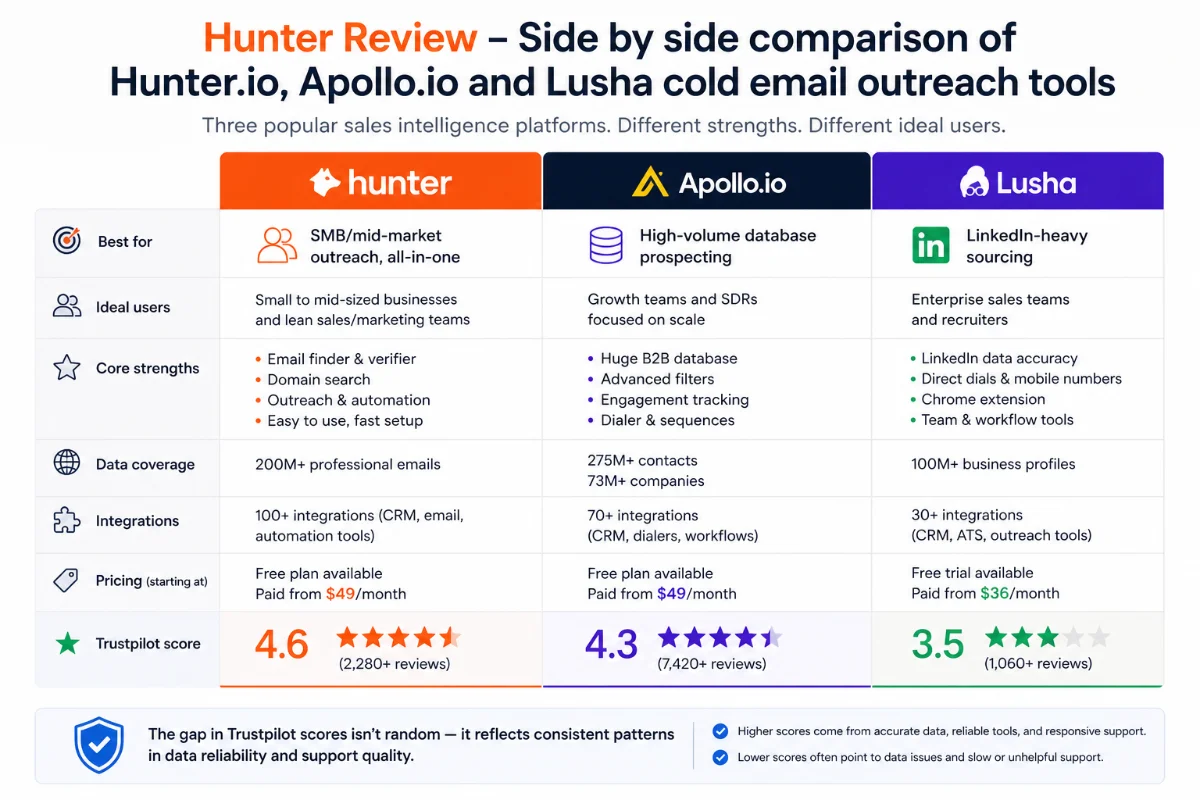
Hunter.io Plan Selection Guide — Which Tier Actually Makes Sense for You
The most common mistake I see people make with Hunter.io is either defaulting to the free plan for longer than they should (and bottlenecking their outreach volume) or jumping to a higher tier before they’ve validated their workflow. Here’s how I’d think about it:
Start on the free plan if: You’re testing cold outreach for the first time, want to validate that Hunter’s data quality works for your specific target companies, or you’re running a very small list (under 50 contacts per month). The free credits are genuinely sufficient for real testing — not just clicking around the interface.
Move to a paid plan when: You’ve confirmed the tool works for your use case and you’re hitting the free credit ceiling consistently. The jump to a paid tier becomes straightforward math — compare the cost against what you’re currently spending on a separate verifier and sequence tool. For most users doing consistent outreach, the consolidation into one platform pays for itself.
Think about higher-tier plans if: You’re running campaigns for multiple clients, doing high-volume bulk domain searches, or need your whole team under one account with shared credits. The bulk credit purchase option (like buying 24k credits upfront, as one reviewer described) can also make sense economically for predictable, high-volume use.
Hunter.io is probably not the right fit if: You’re looking for a massive consumer contact database (Hunter focuses on professional/business emails), you need phone number data alongside email, or you’re doing personal-to-personal outreach rather than B2B cold email. The tool is purpose-built for the professional outreach use case — it doesn’t try to be everything.
Final Verdict — Who Should Use Hunter.io, and Who Shouldn’t
Here’s the honest version, the one I wish I’d had before I wasted two months on tools that cost more and delivered less.
If you’re doing B2B cold email outreach — sales, recruitment, link building, partnerships — and you’ve had your confidence shaken by bounced emails and uncertain data, Hunter.io is the most complete single-platform answer I’ve found at its price point. The confidence score system is the thing I keep coming back to. Not because it’s flashy, but because it’s honest. It tells you what it knows and what it doesn’t, and it lets you make an informed decision rather than gambling your sender reputation on a list you can’t trust.
The all-in-one model genuinely reduces friction. I stopped paying for three separate tools and running data through manual handoffs between them. The campaign sequencing isn’t the most visually polished thing I’ve used, but it’s enough — and the integration with the data layer means there are no import/export errors between your list and your sequence.
The onboarding friction is real, and I’d be dishonest if I didn’t flag it. The LinkedIn connection requirement during sign-up will confuse and lose some legitimate users. That’s a product decision Hunter.io should look at.
You should probably use Hunter.io if: You do B2B outreach regularly, you care about deliverability and domain health, and you want one platform instead of three.
You should skip Hunter.io if: You need phone data alongside emails, you work primarily with consumer audiences rather than business contacts, or you need the absolute maximum database size regardless of verification quality (in which case Apollo might still be the better volume play, accepting the trade-offs).
I remember that Tuesday afternoon staring at 41 hard bounces. I don’t have those afternoons anymore. That’s the version of the story that actually matters.
Frequently Asked Questions About Hunter.io
Is Hunter.io free to use?
Yes. Hunter.io offers a free plan that includes a limited number of monthly search and verification credits — enough to genuinely test the tool’s core functionality before upgrading. No credit card is required to start on the free tier.
How accurate is Hunter.io’s email finder for B2B prospecting?
Based on real user reports and my own campaigns, high-confidence results (above 85–90%) consistently deliver near-zero hard bounce rates. Hunter.io’s transparency about confidence scores means you can filter out riskier contacts before they damage your sender reputation.
Does Hunter.io work for cold email outreach campaigns, or do I need a separate tool?
Hunter.io includes a built-in campaign sequencing module, so you can find contacts, verify them, and send automated follow-up sequences all within the same platform. It’s not as visually complex as dedicated sequencing tools, but for most standard cold outreach workflows, it’s sufficient without adding another subscription.
What’s the difference between Hunter.io and Apollo.io?
Apollo has a larger database; Hunter.io has stronger verification accuracy and significantly better customer support ratings (4.3 vs 3.1 on Trustpilot). If deliverability and data quality matter more than raw volume, Hunter.io is the better choice. Apollo may edge ahead if you need maximum database scale and can accept more list cleaning.
Can Hunter.io integrate with my CRM?
Hunter.io supports CRM integrations including Zoho CRM, as confirmed by verified user reports. The full list of current integrations evolves with product updates, so check the integrations page at hunter.io for the latest connections available.
Is Hunter.io worth it for solo operators or small teams?
Yes, particularly because the free plan is usable rather than performative, and the paid tiers replace the cost of buying a finder, verifier, and sequence tool separately. For solo operators, the credit-based model means you’re not locked into a large monthly commitment if your outreach volume fluctuates.
What are the main limitations of Hunter.io I should know before signing up?
The sign-up process requires a business email and a LinkedIn connection, which some users find unexpected. Coverage for very small or newer companies can be thin. And the email campaign builder, while functional, is less polished than dedicated sequencing platforms if you need complex multi-branch workflows.
How does Hunter.io’s email verification compare to ZeroBounce?
ZeroBounce is a pure-play email verification service with a 4.8 Trustpilot score and a strong reputation specifically for verification accuracy. Hunter.io’s verification is built into an all-in-one outreach platform rather than a standalone service. If your only need is bulk list cleaning with maximum accuracy, ZeroBounce may outperform Hunter.io on that specific dimension — but Hunter.io wins on total workflow value for cold email outreach end-to-end.