

GoHighLevel is worth it for marketing agencies in 2026, but only under the right conditions. After hands-on testing across CRM workflows, automation sequences, and white-label deployments, this platform delivers genuine all-in-one value that replaces a $500+ monthly tool stack for agencies managing multiple clients. The conditional “yes” depends heavily on your agency’s size, technical tolerance, and growth ambitions.
Before diving into the full breakdown, it helps to understand what GoHighLevel actually is and how it operates. GoHighLevel is a SaaS platform built exclusively for agencies and service businesses, consolidating CRM, marketing automation, funnel building, SMS/email campaigns, appointment scheduling, and reputation management into a single dashboard. Founded in 2018 by Shaun Clark and Varun Vairavan, it was engineered from day one to solve the fragmentation problem agencies face when juggling five to ten separate tools per client.
The deeper question most agency owners ask is whether GoHighLevel outperforms dedicated alternatives like HubSpot, ClickFunnels, or Keap. The honest answer is: it depends on your use case. For local business agencies and lead generation shops, GoHighLevel wins on cost consolidation and white-label capability. For enterprise inbound marketing or pure e-commerce, specialized tools still hold the edge. This review examines every angle with enough detail to make that call confidently.
What Is GoHighLevel and How Does It Work as an All-in-One Platform?
GoHighLevel is a cloud-based SaaS platform classified as an all-in-one CRM and marketing automation system, built specifically for marketing agencies and service-based businesses since its founding in 2018. Unlike standalone CRMs or single-channel marketing tools, it unifies pipeline management, multi-channel outreach, funnel building, and client reporting inside one subscription. This architecture means an agency running GoHighLevel no longer needs separate accounts for ActiveCampaign, Calendly, ClickFunnels, Birdeye, or Twilio in many use cases.
To better understand how GoHighLevel delivers this, it is important to examine both its core feature set and its pricing structure in detail.
What Are the Core Features of GoHighLevel in 2026?
GoHighLevel organizes its capabilities into six primary feature groups: CRM and pipeline management, marketing automation, funnel and website building, appointment scheduling, reputation management, and reporting and analytics.
Feature Group 1: CRM and Pipeline Management
The CRM layer handles lead capture, contact tagging, custom fields, and visual pipeline management. Agencies can build unlimited pipelines per sub-account, assign leads to stages, and trigger automations based on pipeline movement. Contact tagging enables granular segmentation across thousands of records without requiring a separate data tool.
Feature Group 2: Marketing Automation
The workflow builder is the operational heart of GoHighLevel. It supports conditional branching, time delays, multi-channel triggers, and integration with external webhooks. Agencies can deploy email sequences, SMS campaigns, ringless voicemail drops, Facebook Messenger messages, and Google Business Profile chat from a single workflow canvas. In 2026, GoHighLevel added native AI steps inside workflows, including a Conversation AI feature that handles two-way SMS conversations autonomously until a human agent takes over.
Feature Group 3: Funnel and Website Builder
The drag-and-drop builder covers landing pages, multi-step funnels, membership sites, and full websites. While the builder is functional and sufficient for most lead generation campaigns, experienced ClickFunnels users may notice the UX is less polished in terms of pre-built design templates. However, the direct CRM integration eliminates the need for Zapier connections that other funnel tools require.
Feature Group 4: Appointment Scheduling and Calendar
GoHighLevel includes a native calendar system that supports round-robin assignment, team calendars, buffer times, and pre-appointment reminder sequences. Booking widgets embed directly into funnels, creating a seamless path from ad click to confirmed appointment without leaving the platform ecosystem.
Feature Group 5: Reputation Management
The reputation module automates review requests via SMS and email, monitors Google Business Profile ratings, and generates review response templates. For local business agencies, this feature alone can justify a portion of the monthly retainer charged to clients.
Feature Group 6: Reporting and Analytics
The reporting dashboard provides attribution tracking across ad sources, pipeline revenue forecasting, call tracking summaries, and appointment conversion rates. Agency owners can generate white-labeled client reports directly from the platform. While these reports cover the essential KPIs, they fall short of the depth available in dedicated BI tools like Databox or Google Looker Studio for complex multi-touch attribution modeling.
What Are the GoHighLevel Pricing Plans for 2026?
GoHighLevel offers three main pricing tiers in 2026: the Starter Plan at approximately $97 per month, the Unlimited Plan at approximately $297 per month, and the Agency Pro SaaS Mode plan at approximately $497 per month.
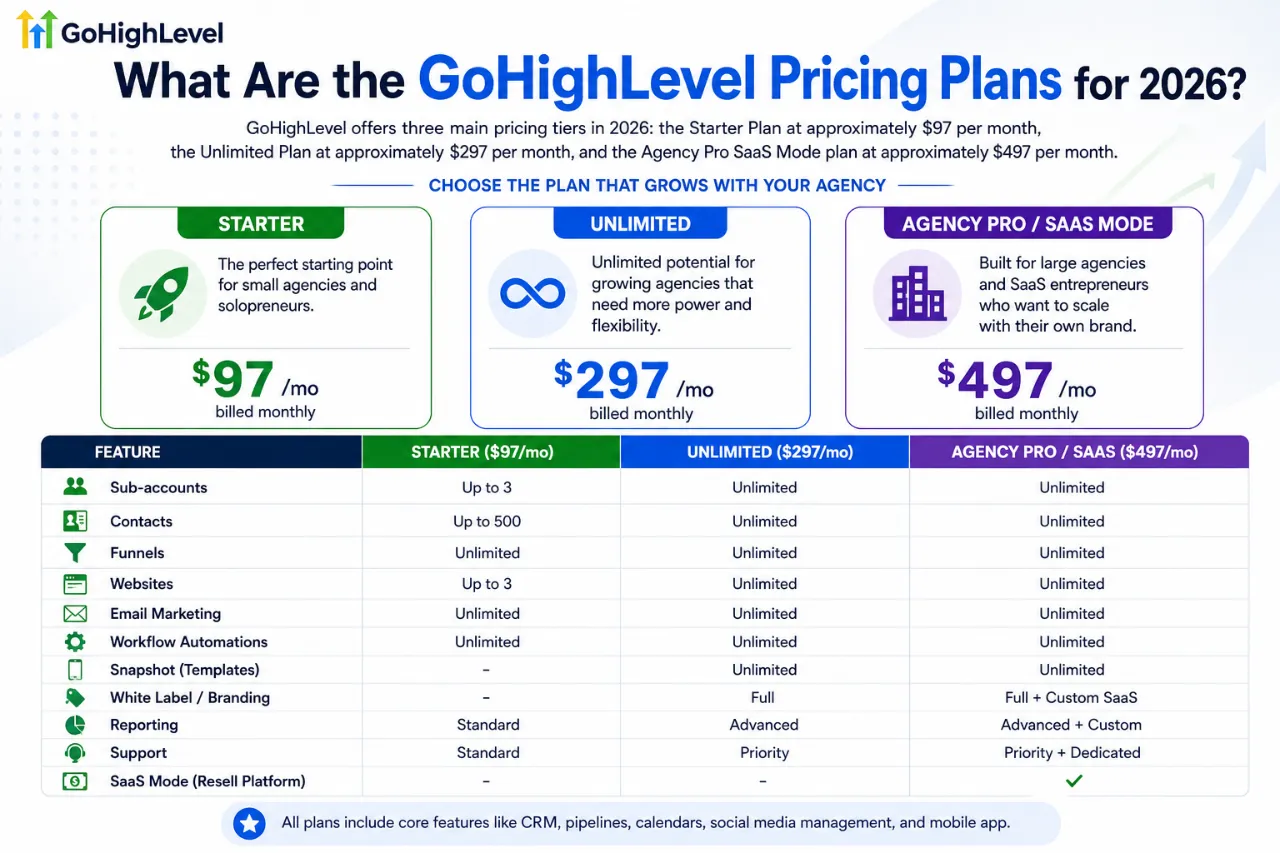
The table below summarizes the key differences across all three plans to help agencies identify which tier matches their operational scale:
| Feature | Starter ($97/mo) | Unlimited ($297/mo) | Agency Pro/SaaS ($497/mo) |
|---|---|---|---|
| Sub-accounts | Up to 3 | Unlimited | Unlimited |
| White-label mobile app | No | No | Yes |
| SaaS reselling mode | No | No | Yes |
| API access | Limited | Full | Full |
| Custom domain | Yes | Yes | Yes |
| AI features | Add-on | Add-on | Add-on |
| Best for | Freelancers | Growing agencies | Scaling agencies |
Starter Plan ($97/month) limits the number of sub-accounts, making it suitable for freelancers or very small agencies managing fewer than three clients. The core CRM and automation features are available, but scalability is restricted.
Unlimited Plan ($297/month) removes the sub-account cap and opens full API access, which is the most popular tier among established agencies. For context, replacing GoHighLevel with equivalent standalone tools typically costs between $400 and $700 per month when combining ActiveCampaign, Calendly, ClickFunnels, Birdeye, and a basic CRM.
Agency Pro and SaaS Mode ($497/month) unlocks white-label branding, a branded mobile app, and the SaaS reselling module. This tier allows agencies to resell GoHighLevel to their own clients under a custom brand name and set their own pricing, creating a recurring SaaS revenue stream layered on top of service retainers.
GoHighLevel offers a 14-day free trial on all plans, which provides full platform access without requiring a credit card commitment at the point of signup.
What Are the Pros and Cons of GoHighLevel?
GoHighLevel has six clear advantages and six notable limitations that agencies must weigh honestly before committing to the platform. This section presents both sides without promotional bias, covering ease of use, customer support quality, and real-world performance constraints alongside the genuine strengths.
The following breakdown addresses each pro and con with enough operational detail to help agency owners assess fit rather than relying on surface-level comparisons.
What Are the Biggest Advantages of Using GoHighLevel for Agencies?
GoHighLevel delivers six major advantages for marketing agencies: all-in-one cost consolidation, complete white-label capability, multi-client sub-account management, powerful automation infrastructure, a community and marketplace ecosystem, and integrated AI features added in 2026.
Pro 1: All-in-One Cost Consolidation
Agencies running separate tools for email marketing, CRM, funnel building, appointment booking, and review management typically spend between $400 and $800 per month across those subscriptions. GoHighLevel replaces the functional overlap of ClickFunnels, ActiveCampaign, Calendly, Birdeye, and a basic CRM for $297 per month on the Unlimited plan. The financial math is compelling for agencies with more than five active client accounts.
Pro 2: Complete White-Label Capability
The Agency Pro plan enables full white-labeling of the platform, including custom domain, branded login screen, and a white-labeled mobile app. Agencies can present GoHighLevel to their clients as a proprietary software product under their own brand name, which increases perceived value, improves client retention, and opens an additional recurring revenue stream.
Pro 3: Sub-Account Model for Multi-Client Management
Each client operates inside a separate sub-account with isolated data, pipelines, automations, and settings. Agency owners access all client accounts from a single master dashboard without switching logins. This architecture makes GoHighLevel operationally superior to tools like HubSpot for agencies that manage ten or more clients simultaneously.
Pro 4: Automation Depth and Scalability
The workflow builder supports complex conditional logic, multi-channel branching, and dynamic data fields that allow agencies to build sophisticated nurture sequences without writing code. Automations can trigger based on pipeline stage changes, form submissions, calendar events, payment completions, or external webhook calls, enabling significant reduction in manual follow-up tasks.
Pro 5: Community and Marketplace Ecosystem
GoHighLevel’s marketplace includes pre-built snapshots (entire account configurations including funnels, workflows, and templates) that agencies can install in minutes for specific niches such as dental practices, real estate agents, or HVAC companies. The official community on Facebook and the HighLevel Ideas board provide continuous peer support and feature influence.
Pro 6: Integrated AI Features in 2026
The 2026 version of GoHighLevel includes a Conversation AI module that handles inbound SMS and chat conversations autonomously, an AI Content Assistant for generating email and SMS copy, and AI-powered review response generation. These features reduce the manual labor of client communication management and position the platform competitively against newer AI-native marketing tools.
What Are the Main Drawbacks and Limitations of GoHighLevel?
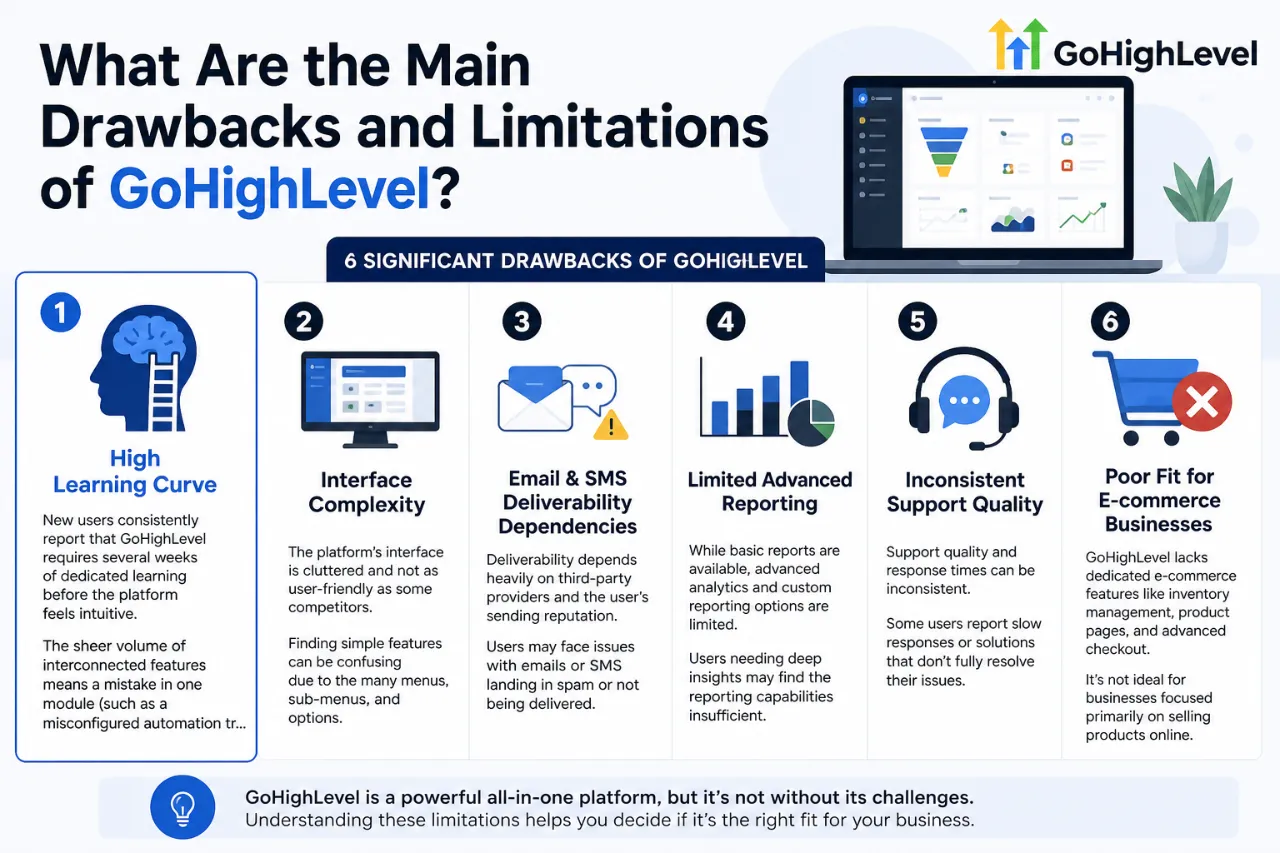
GoHighLevel has six significant drawbacks: a steep learning curve, interface complexity, email and SMS deliverability dependencies, limited advanced reporting, inconsistent support quality, and poor fit for e-commerce businesses.
Con 1: High Learning Curve
New users consistently report that GoHighLevel requires several weeks of dedicated learning before the platform feels intuitive. The sheer volume of interconnected features means a mistake in one module (such as a misconfigured automation trigger) can affect downstream workflows in unexpected ways. Agencies onboarding team members need to budget for training time that does not exist with simpler tools like Mailchimp or HoneyBook.
Con 2: Interface Complexity and Overwhelm
The dashboard attempts to surface all features simultaneously, which creates cognitive overload for users who need only a subset of the platform’s capabilities. Navigation menus are deep, settings panels are duplicated across account-level and sub-account-level configurations, and first-time setup requires working through multiple configuration layers before the platform is operationally ready.
Con 3: Email and SMS Deliverability Dependencies
GoHighLevel does not manage its own email sending infrastructure natively at the core level. Agencies must configure their own Mailgun account or use the LC Email system, and SMS sending requires compliance with A2P 10DLC registration in the United States. Misconfigured sending domains or skipped compliance steps result in poor deliverability that is easy to attribute incorrectly to the platform rather than the setup process.
Con 4: Limited Advanced Reporting
While the built-in reporting covers standard KPIs, agencies running sophisticated multi-touch attribution models or cross-channel performance analysis will find GoHighLevel’s reporting layer insufficient. Integration with Google Looker Studio or Databox is possible via API, but it adds complexity that many agencies prefer to avoid.
Con 5: Inconsistent Support Quality
GoHighLevel offers 24/7 live chat support, but response times and resolution quality vary considerably depending on the complexity of the issue. Technical escalations can take days to resolve, and the support team’s depth of knowledge is inconsistent across shifts. The community forum often provides faster answers for common problems than official support channels.
Con 6: Poor Fit for Pure E-Commerce
GoHighLevel lacks native inventory management, shipping integrations, variant product management, and the checkout experience optimization that dedicated e-commerce platforms like Shopify or WooCommerce provide. Agencies serving e-commerce clients will find the platform’s order management capabilities rudimentary and will likely need to maintain a separate e-commerce stack regardless.
Is GoHighLevel Worth It for Agencies in 2026?
Yes, GoHighLevel is worth it for most marketing agencies in 2026, but the value proposition depends on three specific conditions: the agency manages multiple clients simultaneously, the agency’s primary service involves lead generation or local business marketing, and the agency can invest time in initial platform setup and team training.
More specifically, the ROI calculation, the ideal user profile, and the honest cases where GoHighLevel is the wrong choice all deserve direct examination.
ROI Analysis: GoHighLevel vs. Individual Tool Stack
Consider a mid-sized agency running ten client accounts. A typical tool stack might include ActiveCampaign at $149 per month, ClickFunnels at $197 per month, Calendly Teams at $20 per month, Birdeye at $300 per month, and a basic CRM like Pipedrive at $49 per month. That totals approximately $715 per month before any per-seat or volume overage charges. GoHighLevel Unlimited at $297 per month covers the functional overlap of all five tools with sub-account isolation per client.
The cost difference of approximately $418 per month compounds significantly over twelve months, representing nearly $5,000 in annual savings before accounting for the productivity gains from managing everything inside one platform.
Who GoHighLevel Is Best For
GoHighLevel delivers the highest return for three specific agency profiles:
- Local business marketing agencies that manage SEO, Google Ads, reputation management, and appointment booking for clients in service industries such as dental, legal, medical, real estate, and home services. The sub-account model and reputation management module are purpose-built for this use case.
- Lead generation agencies that run paid traffic campaigns and deliver leads to clients via automated SMS and email nurture sequences. The CRM pipeline plus multi-channel automation workflow creates a complete lead delivery and nurturing infrastructure.
- Agency owners building a SaaS revenue layer who want to white-label the platform and resell it to their own clients as branded software. The Agency Pro plan makes this economically viable with relatively low overhead.
Who Should NOT Use GoHighLevel
Several user profiles are a poor match for the platform:
Solopreneurs and freelancers just starting out face a tool that is operationally more complex than their current needs justify. A single-person operation with fewer than five clients benefits more from simpler, purpose-built tools until their client volume makes GoHighLevel’s sub-account model relevant.
E-commerce store owners and agencies focused exclusively on Shopify or WooCommerce clients will find critical gaps in GoHighLevel’s product management and order fulfillment capabilities.
Enterprise organizations with dedicated engineering teams and existing CRM infrastructure such as Salesforce will find GoHighLevel’s enterprise governance features and data management capabilities insufficient at the $497 price point compared to enterprise-tier alternatives.
Overall Verdict
Across the five core evaluation criteria, GoHighLevel scores as follows: features rate high for agency use cases, pricing is competitive relative to the tool stack it replaces, ease of use rates medium due to the learning curve, customer support rates medium due to inconsistency, and scalability rates high for agencies in the Unlimited or Agency Pro tier. The platform earns a conditional recommendation as the strongest all-in-one solution currently available for marketing agencies managing multiple clients in local business or lead generation niches.
How Does GoHighLevel Compare to Other CRM and Marketing Platforms?
GoHighLevel competes most directly with HubSpot on the CRM side and ClickFunnels on the funnel building side, with each platform winning on different criteria depending on the agency’s primary workflow. This comparison section exists because agencies evaluating GoHighLevel are simultaneously evaluating these alternatives, and the right choice depends on specific use case priorities rather than a single universal ranking.
The following H3 sections examine each comparison pair with direct criteria mapping to help agencies make a final platform decision efficiently.
GoHighLevel vs. HubSpot: Which CRM Is Better for Marketing Agencies?
GoHighLevel wins on pricing, white-label capability, and agency sub-account model; HubSpot wins on inbound marketing depth, enterprise reporting, and ease of use for non-technical teams.
This comparison addresses agencies that are considering HubSpot’s Marketing Hub or Sales Hub as an alternative to GoHighLevel’s all-in-one approach.
Pricing: HubSpot’s Marketing Hub Professional starts at $800 per month for three seats, while GoHighLevel Unlimited costs $297 per month with unlimited sub-accounts and no per-seat pricing. For agencies managing ten or more clients, the cost differential is substantial.
CRM Depth: HubSpot’s CRM is more sophisticated in terms of deal association logic, contact timeline views, and native integrations with enterprise sales tools. GoHighLevel’s CRM is functional and sufficient for lead management but lacks the depth that complex B2B sales cycles require.
White-Label Capability: HubSpot does not offer native white-labeling. GoHighLevel’s Agency Pro plan delivers full white-label branding including a mobile app. This difference is decisive for agencies that want to present proprietary software to clients.
Conclusion: Agencies serving local businesses, running lead generation campaigns, or building a SaaS revenue layer should choose GoHighLevel. Agencies working with mid-market B2B clients on inbound content strategies, or those whose clients require enterprise CRM sophistication, should choose HubSpot despite the higher cost.
GoHighLevel vs. ClickFunnels: Which Platform Should Agencies Use for Funnel Building?
GoHighLevel wins on CRM integration, white-label capability, and overall cost per client managed; ClickFunnels wins on funnel UX polish, pre-built template variety, and ease of use for non-technical creators.
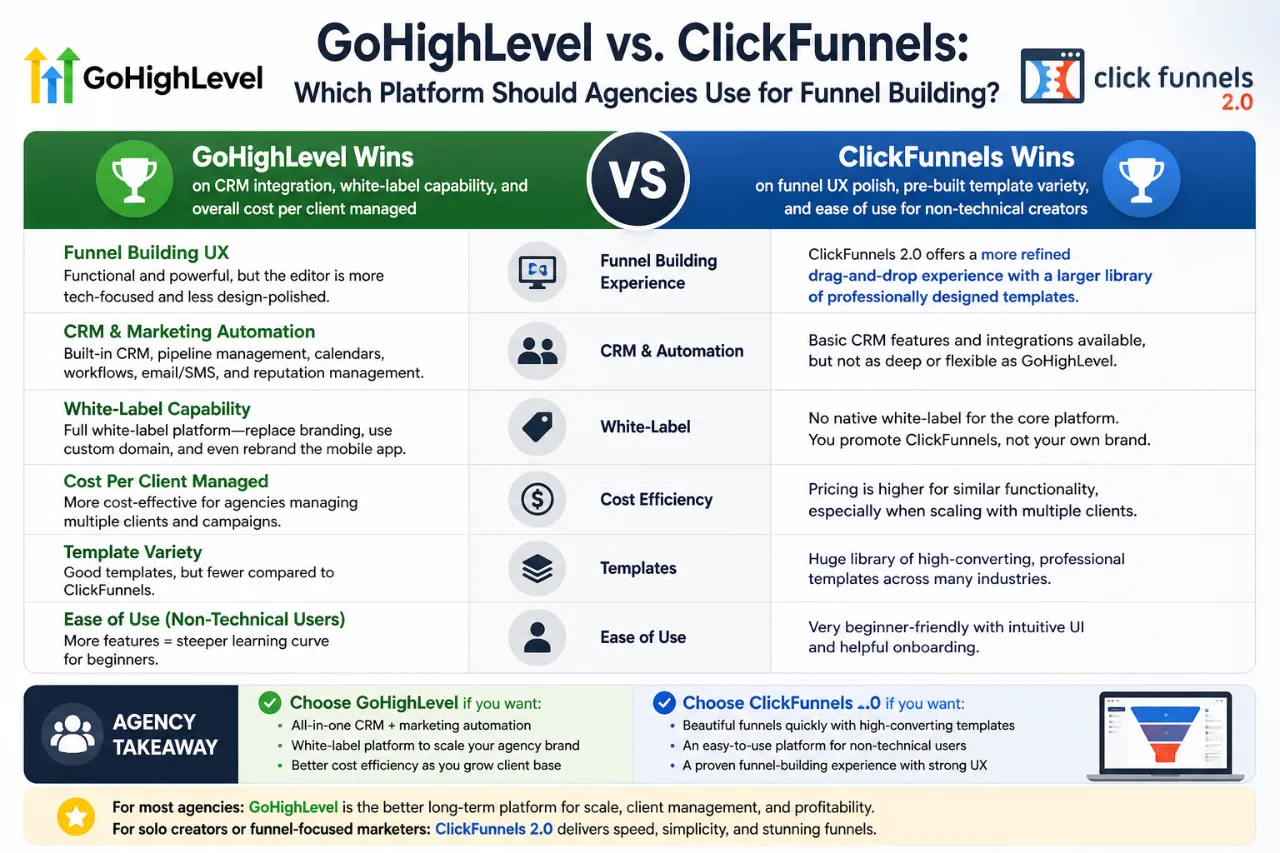
This comparison addresses agencies weighing whether to use GoHighLevel or ClickFunnels 2.0 as their primary funnel and marketing infrastructure.
Funnel Building UX: ClickFunnels 2.0 offers a more refined drag-and-drop experience with a larger library of professionally designed templates. GoHighLevel’s funnel builder is capable but requires more manual design work to achieve comparable visual quality.
CRM Integration: ClickFunnels does not include a native CRM with pipeline management, contact tagging, and multi-channel automation at the depth GoHighLevel provides. Agencies using ClickFunnels for client campaigns typically need a separate CRM, adding cost and integration complexity.
Agency Sub-Account Model: ClickFunnels does not offer a white-labeled sub-account model comparable to GoHighLevel. Managing multiple client accounts inside ClickFunnels requires separate subscriptions or workarounds that increase operational overhead.
Conclusion: Lead generation agencies, local business marketing agencies, and any agency managing client campaigns end-to-end should choose GoHighLevel for its CRM plus automation plus funnel combination. Info-product creators, course sellers, and solopreneurs focused purely on funnel conversion optimization may find ClickFunnels 2.0’s UX and template ecosystem more suitable for their specific workflow.
[…] All-in-One Creator Ecosystem: You don’t need to juggle separate subscriptions for web hosting, keyword research tools, and email marketing platforms. EverBee unites these workflows under one single dashboard login. […]